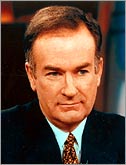
 Here's a transcript of Bill O'Reilly's Attack on Jay-Z BILL O'REILLY, HOST: In the Children at Risk segment tonight, once again, an amazing display of inappropriate behavior by some public schools in the USA. The rapper Jay-Z selling millions of records with corrosive lyrics that demean just about everybody, same old story. A couple of examples, if you aren't a big fan of his: "It's big pimpin' baby, you know, I thug 'em, f-'em, love 'em, leave 'em, 'cause I don't f'n need 'em." All right. Another example: "Keep it moving face off with the .38 scraped off. Keep shorty maced can't throw a 4-4 eight ball know your place." Those are gun slang. Sex, violence, the usual from Jay-Z. In addition, the man was convicted of stabbing a record producer in 1999 and is a self-admitted crack dealer. Now here's the outrage. On a recent promotional tour, the rapper was made an honorary principal at 12 high schools across the country. Joining us now from Detroit, Bill Johnson, columnist for The Detroit News, who wrote an article entitled, "Who Let Jay-Z Into Detroit Schools?" And here in the studio, Kim Osorio, the editor of the hip-hop magazine, The Source. Mr. Johnson, we'll begin with you. How do you see this? BILL JOHNSON, COLUMNIST, THE DETROIT NEWS: This was a total breakdown in school accountability, Bill. First of all, the school administration made -- was irresponsible, as a matter of fact, for leaving it up to the principal to make the decision to let Jay-Z into the schools. The parents bear some responsibility as well for not raising hell when they found out that Jay-Z was on the way to the classroom. As you pointed out, anyone who would take the time to read his lyrics, anyone who would take the time to look at his life history would not think that he was the kind of guy you want to hold before kids, hold as a role model before kids, or have kids emulate. It was a total system breakdown in the Detroit public school system. O'REILLY: All right. Kim, you want to respond? KIM OSORIO, EDITOR-IN-CHIEF, THE SOURCE: Yes, Jay-Z is someone that the kids in Detroit can relate to. He's coming from the same background. You know, he's representing the hip-hop community. And, you know, I think we need to look at him for what he's doing for the community in trying to uplift the community by going into the schools and talking to the kids, speaking from experience, and saying, you know, what's right and what's wrong. You know, obviously, Jay-Z is, you know, one of the biggest rappers out there, and he can have that sort of impact on the kids because... O'REILLY: Well -- but I don't know if he said anything to them like -- give them any life advice, did he? Are you aware that he said, well, here... OSORIO: Well, I know Fairmont Heights High School in D.C. had sent a letter the next day saying that behavior had actually improved. O'REILLY: All right. Mr. Johnson, did you hear what the man's message was as principal of the day? I mean, we're -- we're not -- we're getting conflicting reports here about what his message to the children actually was. Do you know? JOHNSON: I don't know what his message was, but it doesn't matter. He shouldn't have been allowed in the school. For many of these kids in Detroit and in urban areas across the country, the rap music -- gangsta rap becomes a soundtrack for their lives, and they're acting out in -- not only in the schools, but in the day-to-day activities. Detroit is undergoing a major, major spate of violence among teenagers, and I'm inclined to think that some of that is the result of gangsta rap. O'REILLY: Sure. There's no question about it, that it is, and that this is a corrosive -- even if it's not leading directly to gangland activities or shootings or stabbings, it's certainly coarsening children, giving them bad words. We know from teachers say who have come in here and said, "Look, we have 10-year-olds calling other little 10-year-old girls bitches." And, if you incorporate this into your presentation, you will not succeed in this society. You know that. OSORIO: It's a form of entertainment, and I think for... O'REILLY: But is a 9-year-old kid going to understand that? It's a -- you know, it's a lifestyle. OSORIO: His parents should make sure that he understands that. O'REILLY: What if he doesn't have good parents? OSORIO: It's -- it's the parents job to raise... O'REILLY: What if he doesn't have good parents? OSORIO: ... the kids. It's not Jay-Z's job... O'REILLY: Whoa, whoa, whoa. OSORIO: ... to raise... O'REILLY: Jay-Z... OSORIO: I'm a mother myself, so I know. O'REILLY: OK. Yes. And I assume that you're a good mom, right? OSORIO: I hope so. O'REILLY: OK. Well, what if your child didn't have you there? What if you died tomorrow and didn't have anybody responsible to raise your child, and they start listening to this at 10 and 11 years old and start to say those words? Would you be happy about it? OSORIO: Jay-Z is speaking from the hip-hop community. You know what I mean? O'REILLY: All right. You didn't answer my question. Is there a reason you didn't answer it? Would you be happy if your child... OSORIO: Would you like to let me finish answering it? O'REILLY: No, I would like you to answer the question because it's very easy. Do you want your child to use the language that Jay-Z uses? OSORIO: No, I would not like my child to use language that Jay-Z uses. O'REILLY: OK. Now if you weren't there... OSORIO: But that's not the issue here. O'REILLY: Yes, it is. Sure, it is. The issue that Mr. Johnson is trying to get across is that for the public school system to endorse this man, to give him an honorary principal title, all right, is basically sending a message that his behavior is OK. OSORIO: What behavior? Jay-Z is speaking from experience and coming from the neighborhood that he came from, from Marcy Projects in Brooklyn -- You know what I mean? -- turning his life around, is showing that, look, I had to come out of that. He wasn't born with a silver spoon in his mouth. O'REILLY: That's fine. You can have an inspirational rags-to-riches story... OSORIO: Right. O'REILLY: ... without calling women hos and using people and this and that. Am I... OSORIO: I mean, it's a form of entertainment. O'REILLY: I understand that. OSORIO: You know, it's not always that a woman is being called a ho. I-- what about Hollywood and the way that they depict women? O'REILLY: Well, you can't justify anybody's behavior by pointing to somebody else's worse behavior. I think that's... Where is she going wrong, Mr. Johnson? Where is Kim going wrong? JOHNSON: I have nothing -- I have absolutely nothing against gangsta rap or hip-hop, the hip-hop culture. I think it's -- if people want to accept that -- it's part of a genre -- that's fine with me. My point is that it doesn't belong in the schools. If -- the language is reprehensible, it denigrates women, it glorifies rape and violence, and it just simply doesn't belong in the schools, and any school administrator or an official that lets it into the schools ought to be sanctioned themselves. O'REILLY: OK, but Ms. Osorio is saying, to get through to these kids, you've got to use somebody that they trust and admire, and they do trust and admire Jay-Z. JOHNSON: I think that's nonsense. I think they would have more respect for someone like Colin Powell or Condoleezza Rice, someone who has made an outstanding contribution to society. O'REILLY: Do you really? Do you really think that they would respect them more than Jay-Z? They probably wouldn't even know who those people were, Mr. Johnson. JOHNSON: Well, I think it's the failure of parents. If Jay-Z becomes the icon, it's the failure of parents. O'REILLY: Yes. That's for sure. JOHNSON: Pure and simple. O'REILLY: Now do you understand that the public school might not be the right place for Jay-Z to show his wares? Do you understand that? OSORIO: Why not? O'REILLY: Because, as Mr. Johnson pointed out and I concur, he brings a message of the street, and the school really isn't a place for that. The school is to try to uplift you, to try to educate you, not to teach you how to say the F word 15 times in a sentence. OSORIO: I don't think that Jay-Z's message is teaching kids how to say the F word in a sentence. O'REILLY: But that's what he does. That's all he does. OSORIO: Oh, that is not all he does. O'REILLY: Yes, it is. That's pretty much all he does. OSORIO: That is not all he does. O'REILLY: I've got his lyrics here of seven songs, and there's an F word in every single sentence. OSORIO: And what lyrics are those? Like from what album? And I think of him growing as an artist... O'REILLY: Well, I've got "Missy Misdemeanor," OK. That's his new CD. I've got "Life & Times of S. Carter." OSORIO: Let's talk about... O'REILLY: I've got all the ones your magazine pump out like crazy. OSORIO: Let's talk about the "Missy Misdemeanor one where, you know, he actually calls you out on attacking the hip-hop culture. O'REILLY: Yes, he called me out and called me an F name, right? Didn't he? There you go. Made my point. OSORIO: Oh, no. O'REILLY: Yes. OSORIO: Come on. Oh... O'REILLY: Kim, thank you. OSORIO: OK. O'REILLY: All right. Mr. Johnson, we'll let the audience decide. Jay-Z did say F me, OK? But I don't care. You know, that's all right. Not in the public school |