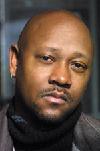
 Who is the Gay Rapper? That's a question that obsessed people after the Connecticut publication One Nut set off a firestorm of speculation a few years ago by publishing a series of interviews with an anonymous well-known rapper who claimed to be gay. Hip-hop fans and industry insiders went on a witch hunt, analyzing lyrics and theorizing about various artists' offstage behavior. Stars ranging from LL Cool J to Dr. Dre to Jay-Z to Method Man found their sexual orientation being called into question. Sadly, the fascination was fueled by prevalent gay stereotypes. Far too many people seem to think that being gay would somehow prevent a rapper from busting a mind-altering dance move or kicking a dope freestyle. But such notions are ridiculous. After all, there are gay policemen, accountants and doctors who are as good at their jobs or better than their straight colleagues. So why couldn't the Gay Rapper be a superstar? A listen to the tracks ``Straight Trippin' '' or ``Fam Biz Edit,'' put out by Bay Area rappers Tim'm T West and Juba Kalamka with their crew, D/DC (Deep Dick Collective), lays to rest any idea that gay rappers lack the necessary skills. Over the past couple of years, D/DC has built a strong reputation at its frequent shows for both gay and straight crowds. The D/DC group is best known for its innovations -- fusing spoken-word, as well as straight-up rap, with the music. Their current CD has a title that's hard to confuse with any other, ``Bourgiebohopostpomoafro Homo,'' and they're working on a new disc, ``The Famous Outlaw League of Proto-Negroes,'' due out in the fall on the Sugartruck/Agitprop/Cellular label. Check out the Web site gayhiphop.com to sample D/DC's music. Another Bay Area artist who is openly gay and has forged an awesome reputation as an innovative rhymer is Hanifah Walidah. She first hit the scene in 1994 using the name Sha-Key, having released the impressive album ``A Headnodda's Journey.'' Her single ``Soulsville'' was ahead of its time because it fused rap with spoken-word years before that would become common. Walidah is featured on the new compilation album ``Shame the Devil'' (Freedom Fighter Records), and she's at work on a hip-hop opera. Hanifah and D/DC are just a few of the gay artists taking their rightful places in the world of hip-hop, and these artists are building upon the trailblazing spirit of earlier gay hip-hoppers. The Bay Area owes a debt of gratitude to people such as Page Hodell, one of the first women to do a live mix show on commercial radio, working the turntables on KSOL in the mid-'80s. She rivaled, and often surpassed, her male counterparts. Hodell also deejayed and produced one of the country's longest-running hip-hop clubs. The Box, as it was called, ran for more then 10 years in San Francisco, attracted thousands of clubgoers, mostly gay, and became a Bay Area institution. Props are also due for Dave Moss, who was on KSOL's up-and-coming rival station, KMEL, at the same time as Hodell. KMEL was then known primarily as a dance station, but on Saturday nights Moss would put together incredible East Coast-style break beat/hip-hop mixes that are still talked about today. DJ Neon Leon, well-known in London and among house music fans everywhere, started in the mid-'80s as a hip-hop DJ on KALX, the University of California-Berkeley station. He later earned his stripes as a Hip Hop club DJ at the now-defunct I-Beam. We could go on and on naming gay artists who have made an impact on hip-hop. Gays have always been down with hip-hop. The question is: Do we accept our gay brothers and sistas? So who is the Gay Rapper? He or she might be the victor of a fierce rhyme battle or the artist whose record you dance to every time it's played on the radio or at a club. So what difference does it make? |